The Journey Through Story of the World in Our Homeschool
Story of the World has become one of the richest parts of our homeschool rhythm, blending history, geography, reading, writing, narration, and deep discussion into one connected learning experience. In this post, I share how we use it as a multi-subject anchor that sparks curiosity long after each chapter ends.
Lorena CM
11/6/20253 min read
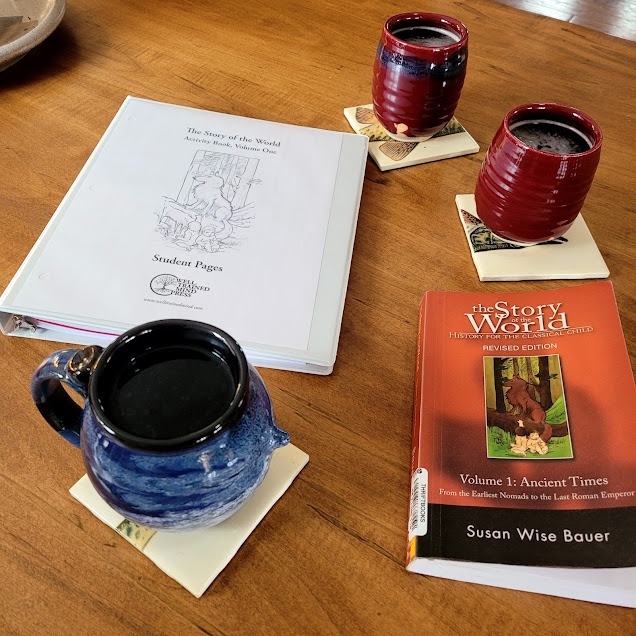
How We Use Story of the World in Our Homeschool
A deeper look at how one book brings multiple subjects to life
One of the most meaningful parts of our homeschool this year has been our journey through Story of the World: Volume 1. What began as a simple history resource has become a central thread in our learning, guiding our discussions, shaping our writing work, and sparking curiosity that carries well beyond the page.
In a world where curriculum can feel fragmented and compartmentalized, Story of the World has offered us something different: a connected, narrative-based foundation that naturally blends history, geography, reading, writing, and critical thinking in a way that feels organic and deeply engaging.
History as a Living Story
Rather than memorizing isolated facts or dates, we explore history through story. Each chapter introduces civilizations, people, and ideas in a way that feels alive and human, not distant or abstract.
I’ve watched my children lean in, ask questions, and truly picture life in ancient times, even independently reading the book or listening to the Audible version on their own. We discuss a wide range of topics, such as:
What did daily life look like for someone in ancient Egypt, Cannan, or under King Hammurabi's Laws?
How did geography impact early settlements?
Why do certain inventions change everything?
These aren’t questions I push. They emerge naturally when history is told through narrative rather than bullet points.
The stories open the door, but the curiosity takes over from there.
Narration, Writing, and Meaningful Language Work
After each reading, we spend time narrating, a simple practice that builds powerful skills. The boys retell the story in their own words, strengthening:
Listening comprehension
Vocabulary and memory
Sequencing and organization
Speaking confidence
Some days this looks like oral retellings at the breakfast table, during car rides, or even to complete strangers who innocently asked what their favorite subject is; other days it looks like long conversations over piles of ancient history books pulled out to verify facts or paintings of maps, battles, or fierce rulers. We are slowly learning to move thoughts from mind to voice to paper, a foundational skill in classical education.
And the best part? The work we do feels purposeful, not forced.
Mapping the Ancient World
Geography has become one of the most rewarding parts of our Story of the World routine. Together, we trace ancient trade routes, identify rivers and mountains, and watch how civilizations formed around natural features.
Through mapwork, they begin to understand:
Why people settled where they did
How natural barriers shaped culture
The connection between geography and survival
How ancient regions relate to modern borders
It's early geography, anchored in real context, not random map drills. We’ve traced the Nile, located Mesopotamia, followed traders, and shaded early empires.
Each map tells a story of its own.
Rich Conversations That Continue Long After the Lesson
Story of the World doesn’t end when we close the book.
Some of our best discussions happen hours later, at lunch, in the car, or with friends and family:
“Why do some civilizations disappear?”
“Would we rather live by a river or in the mountains?”
“What makes a leader good or bad?”
History becomes a springboard for ethics, logic, personal values, and worldview formation, naturally and without pressure.
When Curiosity Becomes a Rabbit Trail
More often than not, a chapter leads us deeper into books about ancient Egypt, archaeology videos, new recipes, or nature walks that spark parallels between ancient farming and modern ecosystems.
We’ve researched pyramids, explored cuneiform writing, and compared early tools to the ones we use today.
Not because a curriculum told us to, but because curiosity led the way.
And when curiosity leads, learning sticks.
Why Story of the World Works for Our Family
This program works for us because it is:
Story-based, not worksheet-based (although we absolutely love the activity pages and mapwork for each chapter)
Flexible and adaptable for multiple ages (both 5- and 7-year-old participate fully)
Easy to integrate with journaling and classical skills
Naturally interdisciplinary
Curiosity-driven and discussion-heavy
It's simple, yet rich. Structured, but alive.
Exactly the kind of learning we value in our home.
Looking Ahead
We are only though the early chapters of world history, yet it already feels like we’ve opened a door into a much bigger world, one full of patterns, lessons, and ideas.
As we continue reading, narrating, mapping, and exploring together, I’m reminded that real history isn’t something you memorize, it's something you observe, question, and carry forward.
And so far, Story of the World has been the perfect place to begin.
Want to see how I pair SOTW with notebooking, map work, and books?
Next up, I’ll be sharing:
How we use SOTW to inspire our morning journal writings
How we discuss sensitive subjects that naturally exist throughout history
Our favorite books and resources that complement SOTW
Simple extension ideas for younger and older learners
Contact
mindfullyeducatedmn@gmail.com