Embracing Our Homeschool Journey: Reflections from Our First Quarter with HBEAA
Our first quarter of homeschool brought growth, rhythm, and reflection. With HBEAA accreditation, we’ve found balance between structure and freedom, strengthening academics, embracing curiosity, and learning right alongside my children.
Lorena CM
10/28/2025
Embracing Our Homeschool Journey
As we close our first quarter of the homeschool year, I’ve been reflecting on what this season has taught us about rhythm, growth, and purpose. This is our 2nd year of choosing to accredit our homeschool through the Home-Based Educators’ Accrediting Association (HBEAA) - a partnership that brings structure, accountability, and freedom together in a way that truly supports our family’s goals.
HBEAA has allowed us to align our studies with Minnesota’s standards while still honoring the flexibility that makes homeschooling meaningful. It’s a structure that works with our rhythm, not against it, giving us room to explore, adapt, and create while still providing a clear academic path. I’ll be sharing more about our HBEAA experience in a future post, including why we chose it and how it helps us balance both independence and intention in our homeschool.
A Season of Foundations
This fall has been focused on building strong academic and personal foundations. Two of our three boys are currently being homeschooled, one in second grade (age 7) and one in first grade (age 5). They are each working across multiple grade levels, moving forward at their own pace in different subjects. Some days that can be tackling lessons well above their grade level; other days, it’s about slowing down and practicing fundamentals until they feel solid.
In language arts, our focus this quarter has been on reading, spelling, grammar, and sentence formation - the foundational skills that make confident writing possible. The boys enjoy reading classic stories like The Hardy Boys, Winnie the Pooh, and Tom Sawyer, using them as springboards for vocabulary, narration, and discussion. While we do spend time on grammar exercises and structured sentence work, much of our deeper learning happens through everyday conversations; the kind that spark critical thinking, connect ideas across subjects, and help us write with both meaning and intention.
We’ve also embraced notebooking as a daily part of our learning process. It’s become a space for recording discoveries, organizing thoughts, spelling tests, copywork, and blending subjects naturally. Whether journaling about our day or weekend, labeling a nature sketch, or writing new Latin vocabulary, notebooking has helped tie learning together, encouraging reflection, comprehension, and personal expression.
Math & Critical Thinking
Mathematics this quarter has focused on fluency, reasoning, and flexible problem-solving. Both boys have been using Synthesis Math off and on for over a year now, which is a program that emphasizes conceptual understanding through story-driven problem sets and logic-based challenges. It’s been an engaging way to help them think deeply rather than simply follow steps.
Our main math lessons consist of traditional math skills through daily review and hands-on applications. Our second grader has been working with more advanced number patterns, multi-step problems, and early multiplication and division, while our first grader is mastering foundational number sense, addition, and subtraction. Math also finds its way into everyday life, measuring ingredients while cooking, calculating distances and time, or comparing quantities during everyday life. It’s a subject that never stays on the page for long; it lives in everything we do.
Health, Safety, & Well-Being
Health and safety are naturally woven into our daily rhythm rather than taught as isolated lessons. We focus on everyday habits that build awareness, independence, and responsibility, simple skills that become part of who we are.
This includes maintaining good personal hygiene, recognizing personal space and emotions, and making safe choices during outdoor exploration and seasonal changes. Many of these lessons emerge in real moments: understanding boundaries, identifying safe foods in nature, and discussing which foods we choose to eat regularly versus those we limit, including those that we cannot eat and why.
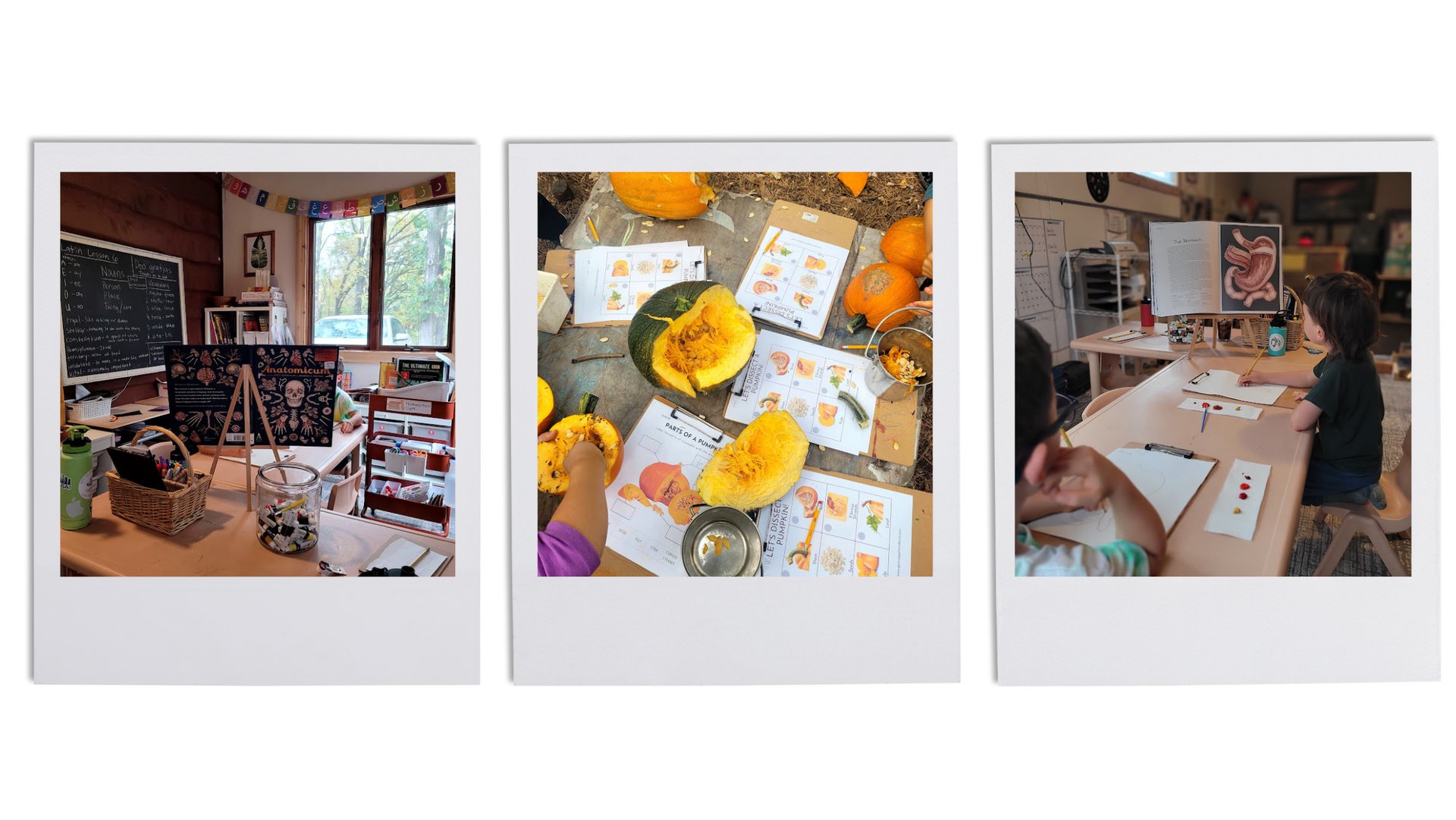
Our studies have also led to conversations about how the human body works. Recently, we explored the topic of brain neurons; how they function, how they differ among species, and how that affects behavior and decision-making. These discussions have helped the boys connect science to real life, understanding that health is more than just what we see or feel physically.
Science & Physical Activity
Science this quarter has taken us outdoors through the Nature Explorers enrichment program at Oak Ridge Nature School. This multi-session experience has grounded our science learning in real observation and hands-on discovery, exploring ecosystems, seasonal changes, and local wildlife through fun activities and free-time in nature. Each session encourages curiosity, exploration, and a deeper understanding of how interconnected the natural world really is.
Much of our physical activity also happens through our daily living, free exploration through our woods, climbing, balancing, and engaging in movement that builds both strength and coordination. Our weekends often include bike rides, a round of golf, tennis, and plenty of unstructured outdoor play, giving the boys space to develop endurance, confidence, and a love of movement.
Together, science and physical exploration have complemented one another, learning how the world works by experiencing it firsthand.
Exploring Classical Roots
Our introduction to Prima Latina has been one of this quarter’s most exciting additions. The boys have enjoyed learning simple phrases, vocabulary, and Latin roots, and it’s been rewarding to see how this classical foundation connects to their understanding of English grammar and spelling.
Our history studies through Story of the World: Volume 1 have taken us deep into ancient times, exploring early civilizations, inventions, and the beginnings of human storytelling. What I’ve loved most about this resource is how naturally it connects across subjects. Each chapter sparks new directions in writing, reading, geography, and map work, allowing history to become the thread that ties so much of our learning together.
After reading each story, we often expand it into short narrations, dinner-table discussions, or notebooking pages that help organize thoughts and strengthen composition skills. Map work has become one of our favorite extensions, tracing ancient trade routes, identifying modern-day countries, and seeing how geography has shaped culture and exploration.
Story of the World has been both valuable and enjoyable for us, blending storytelling, structure, and discovery in a way that keeps everyone engaged. It’s one of those rare resources that consistently invites conversation, deep thinking, and genuine excitement for what comes next.
Music & the Arts
Our homeschool rhythm also includes music lessons, piano for our first grader and guitar for our second grader. The boys are learning not only technique but also discipline, focus, and the joy of creating something from practice.
Art finds its way into our days, usually on rainy mornings, or as we listen to an audiobook on the Eastern Orthodox Saints, Beatrix Potter, or Biocentrism. Whether painting human organs of interest (heart, stomach, brain), sketching our favorite trees and seasons, or experimenting with crayons, colored pencils, or paints, it continues to serve as both a creative outlet and a tool for processing information across subjects.
Community & Connection
One of the many things I appreciate about being accredited through HBEAA is that community involvement is a required subject. It’s a reminder that education extends far beyond the home, that children grow not only through lessons, but through experiences that connect them to the people and places around them.
This expectation has encouraged us to be intentional about seeking opportunities within our community. Between building and maintaining friendships though the Homeschool Enrichment Sessions at Oak Ridge Nature School, local events, and impromptu park interactions with peers, the boys have had many chances to collaborate, share ideas, and learn through social experiences.
Looking Ahead
As we move into our second quarter, I’m looking forward to incorporating some of the new ideas and approaches I’ve discovered over the past few months. Homeschooling has its own natural pace, a steady rhythm of observing, adjusting, and finding what works. We’ll continue to focus on what’s been working well while making small shifts to increase both interest and participation in the areas that need fresh energy.
Just as the boys are learning, I’m learning too; about education, about them, and about myself. Lately, I’ve found encouragement and inspiration through a few homeschooling podcasts that remind me how flexible and adjustable this journey really is. Each day gives me a chance to learn something new right alongside my boys. I’m constantly reminded that this isn’t just their education, it’s mine too.
Contact
mindfullyeducatedmn@gmail.com